
When NVIDIA’s Jensen Huang said China is winning the AI race, he wasn’t entirely wrong. He just said it too early.
The U.S. government’s decision to ban advanced NVIDIA chips from being sold to China was meant to slow China’s AI progress. It did, temporarily.
But it also forced China to build its own chip manufacturing and software ecosystem. Fast forward to today: China is banning NVIDIA chips and moving toward self-reliance. The seeds of long-term competition were planted by U.S. policy itself.
Here’s the irony:
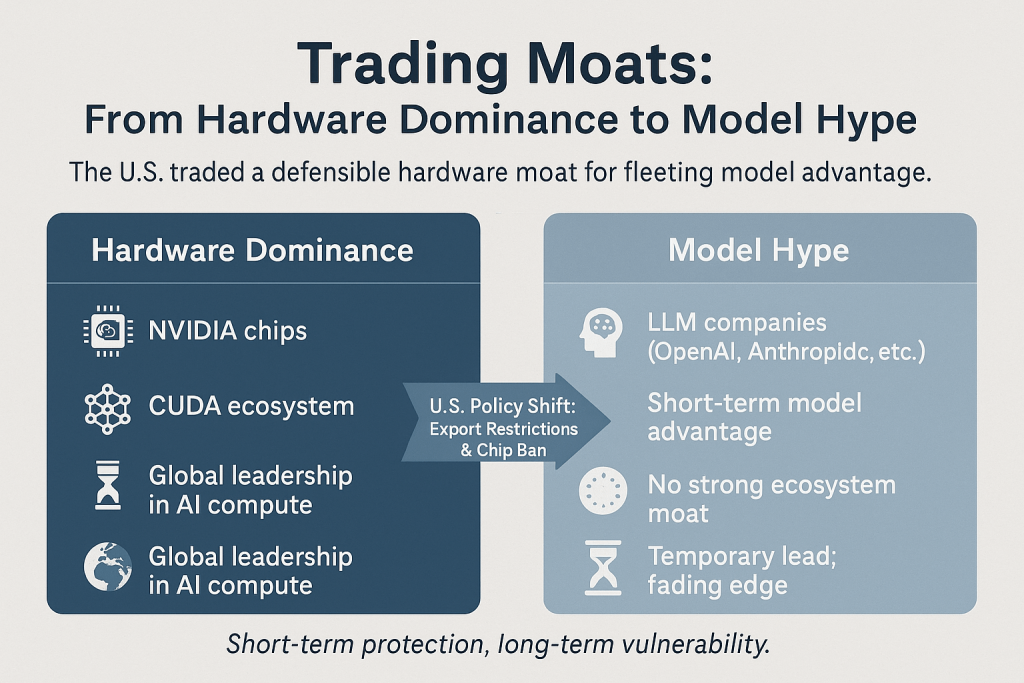
By trying to “win” the AI race, the U.S. may have traded a strong, defensible moat (NVIDIA’s hardware ecosystem) for weaker, temporary moats (AI models from tech companies).
If you were running a company, would you sacrifice your best long-term asset for short-term growth? That’s essentially what happened.
Yes, the decision benefited OpenAI, Anthropic, and other U.S. AI players in the short run. With fewer buyers in China, they got cheaper GPUs and dominated the headlines.
But none of these companies have moats comparable to NVIDIA’s CUDA ecosystem, the true foundation of AI computing.
Now we’re watching China close the gap, building its own stack from silicon to software. And when that happens, the “AI race” narrative will flip.
Do I think that’s a disaster? Not really.
Both countries will keep advancing. Innovation doesn’t stop at borders.
What worries me more is how this “U.S. must win the AI race” slogan has been used — often to justify more funding, lobbying, or protectionism from big tech firms looking ahead to the next bailout.
Maybe it’s time to stop treating AI as a geopolitical trophy. Compete fairly. Build stronger moats. And let innovation, not fear, drive progress.
What’s your take: did the U.S. outsmart itself in the AI race?
#AI #TechnologyPolicy #Semiconductors #Innovation #China