

A friend of mine recently received an email from a mother whose child has been suffering from Wilson’s disease. The existing drugs have serious side effects and are not very tolerable. She was desperately looking for alternatives.
We decided to help. Using our IExplore tool on the BioKDE platform, we performed a drug repurposing analysis for Wilson’s disease (Figure 1). The first search returned several drugs, but most were for alleviating symptoms rather than addressing the root cause.
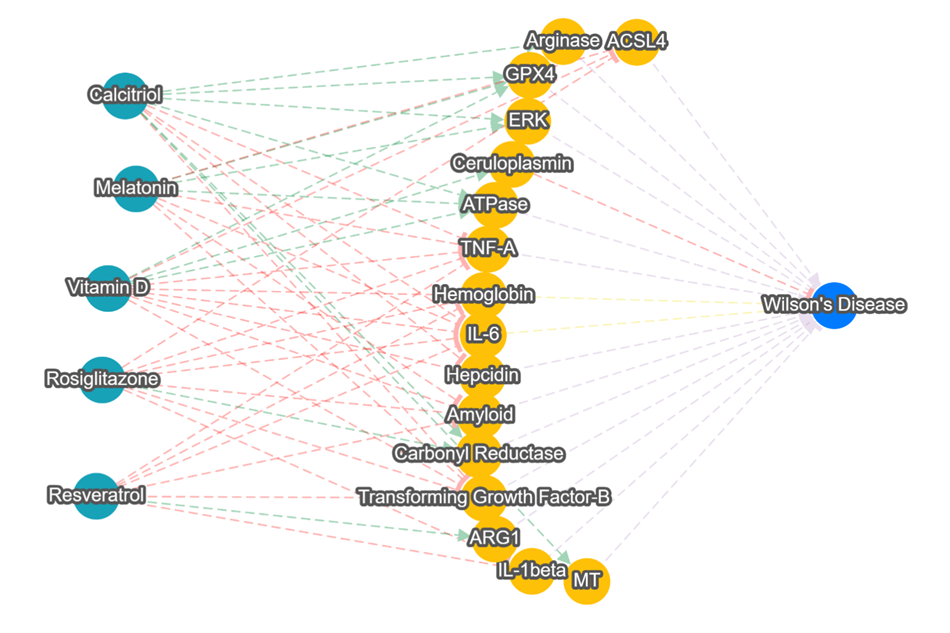
Figure 1. Network diagram linking potential drugs (left) to biological targets (center) that connect to Wilson’s disease (right), showing multiple drug-target-disease relationships.
Wilson’s disease is caused by a genetic defect in ATP7B, a copper-transporting protein. When it fails, copper accumulates in the liver, brain, and other organs, leading to severe damage.
We noticed that one common treatment—zinc salts—works by inducing metallothionein, a protein that binds copper and prevents absorption. This gave us an idea:
What if we find drugs that can increase metallothionein expression?
Searching again, we found Cilostazol, a drug mentioned in multiple studies (PMIDs: 19881214, 21467742, 17409522, 16952340) to increase metallothionein, especially the MT3 isoform expressed in the brain. This could potentially help reduce copper-induced neurological damage (Figure 2). A search on PubMed and Google found no relationships mentioned between Wilson’s disease and Cilostazol.
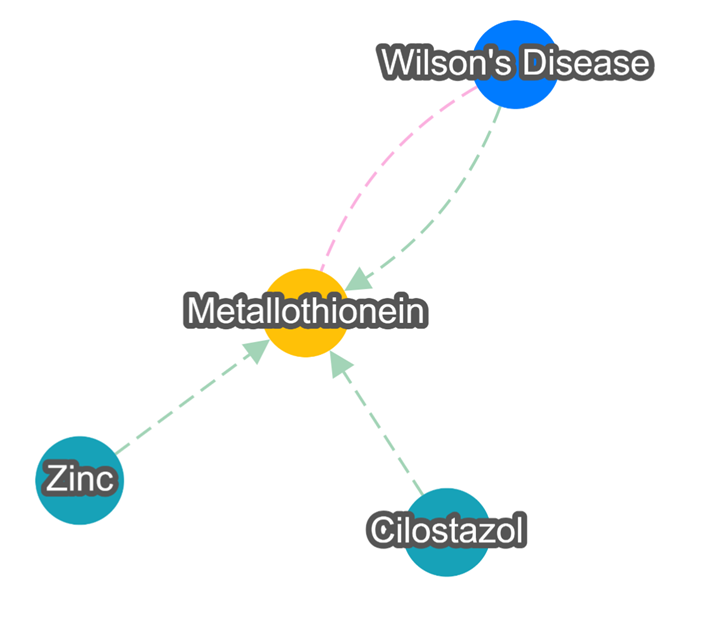
Figure 2. Central node “Metallothionein” connected by arrows to “Zinc” and “Cilostazol” and linked toward “Wilson’s Disease” suggesting therapeutic relationship between Cilostazol and Wilson’s disease.
We are not Wilson’s disease experts, so we share this publicly to invite feedback. If this hypothesis seems plausible, perhaps researchers in this area could explore it further.
We are now expanding this approach to repurpose drugs for all rare diseases and have found potential new treatments for over 2,000 rare diseases. If you know anyone seeking potential treatments for a rare disease, please reach out and we’d be glad to explore it.
This work also reminds us that AI still needs humans in the loop. Our initial model overlooked metallothionein because it assumed reducing its expression might help. In reality, it’s a protective response. Human reasoning was key to catching that. In a future post, I will explain in details how we found Cilostazol using our knowledge graph-powered tool.
#AIinHealthcare #DrugRepurposing #RareDiseases #BiomedicalAI #WilsonDisease