
Malignant Pleural Mesothelioma is one of the most difficult cancers to treat. Its biology is driven by inflammation, fibrosis, and a highly suppressive tumor environment. This makes it an important target for new ideas.
Using our AI-powered drug repurposing platform with human-in-loop review, we found something unexpected: Alteplase, a clot-dissolving medication used for stroke, heart attack, pulmonary embolism, and catheter blockages, may have a biologically plausible connection to MPM. Alteplase has never been investigated for this cancer.
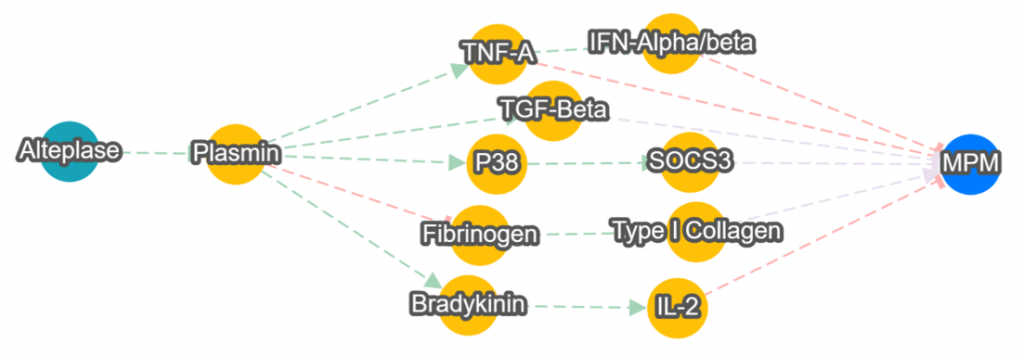
Mechanistically, Alteplase converts plasminogen to plasmin. Plasmin is usually associated with breaking down fibrin. What our system revealed is that plasmin interacts with many pathways active in the MPM microenvironment. These include inflammatory cytokines like TNF-A and IFN-alpha/beta, immune regulators like SOCS3 and IL-2, fibrotic drivers like TGF-beta, and stromal components such as fibrinogen and collagen. There is even a path from Alteplase to plasmin to p38 to SOCS3 and finally to MPM.
Individually, none of these interactions would point to an obvious therapeutic effect. But taken together, they outline a non-obvious biological story. MPM is heavily driven by chronic fibrosis and a rigid extracellular matrix. Plasmin is one of the body’s key regulators of fibrin breakdown, collagen remodeling, cytokine activation, and immune cell recruitment. This makes the hypothesis scientifically plausible.
Of course, the net effect could be complex. Some plasmin-driven pathways may help the tumor while others may inhibit it. There are no clinical reports of Alteplase being used for solid tumors. This is exactly why AI-assisted reasoning is valuable. It highlights mechanisms that deserve deeper scientific attention, even when the final answer is not straightforward.
We share this as an example of what an AI-enabled platform can surface: hidden, mechanistically rich connections that humans would rarely consider. This is not a claim of efficacy. It is an invitation to explore.
If you work in mesothelioma, fibrosis, or tumor microenvironment research, we would love your thoughts. Is this direction worth further investigation? What experiments would you run to test it?