
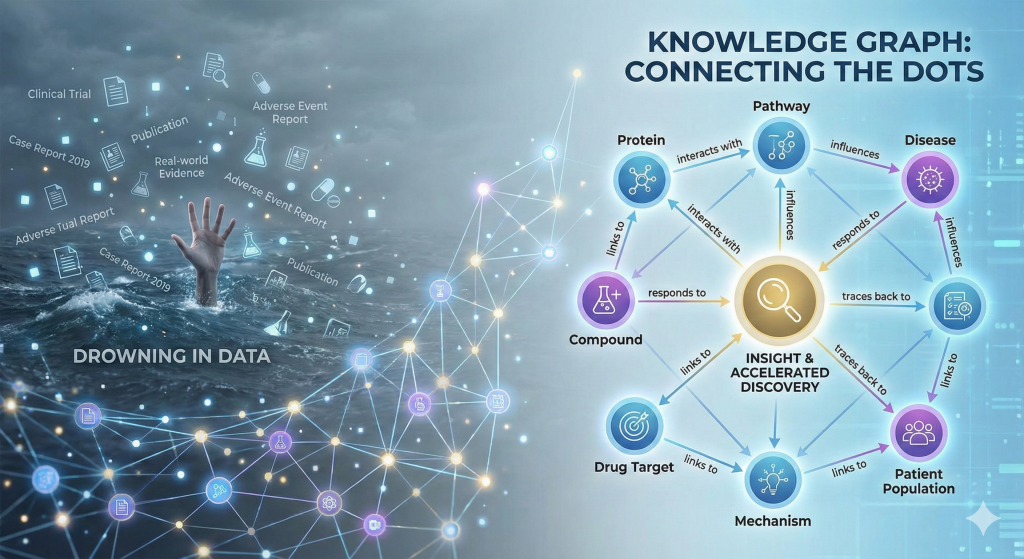
We are drowning in data but starving for insight.
Every day, the biomedical literature grows by thousands of new publications. Clinical trial databases expand. Real-world evidence accumulates. Adverse event reports pile up. And somewhere buried in all of that noise is the connection that could accelerate your next discovery.
The problem is not access. The problem is connection.
Traditional databases store information in neat rows and columns. But biology does not work that way. A protein interacts with a pathway that influences a disease that responds to a compound that was mentioned in a case report from 2019 that nobody remembers reading.
That is where knowledge graphs change everything.
Instead of forcing complex relationships into rigid tables, knowledge graphs represent information the way it actually exists: as an interconnected web of entities and relationships. Drug targets link to mechanisms. Mechanisms link to diseases. Diseases link to patient populations. And suddenly, patterns emerge that would take years to find manually.
For those of us in drug discovery and pharmacovigilance, this is not a nice-to-have anymore. It is becoming essential infrastructure.
When you need to identify off-target effects across millions of data points, knowledge graphs scale. When you need to trace a safety signal back through biological mechanisms, knowledge graphs connect the dots. When you need to repurpose existing compounds for new indications, knowledge graphs surface hidden opportunities.
The explosion of unstructured data is not slowing down. The question is whether your organization can turn that complexity into competitive advantage.
How is your team currently managing the challenge of connecting insights across disparate data sources?
#DrugDiscovery #KnowledgeGraphs #Pharmacovigilance #AIinPharma #DataScience